
Focaccia Siracusana
in Sicilian:
Cuddurúni
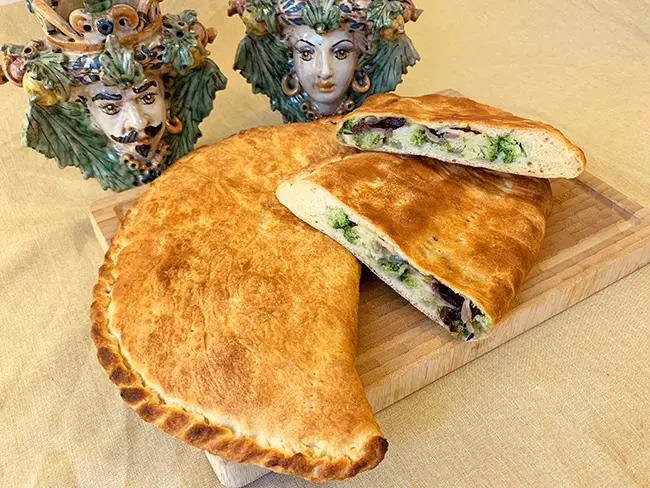
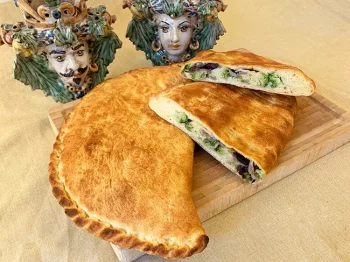
Focaccia Siracusana, also known as Cuddurúni, is baked in the oven and consists of a bread dough filled with sweet onions, broccoli, Pecorino, olives, and anchovies. A key and characteristic feature of Focaccia Siracusana is its crescent shape.
The dough for this focaccia from the region around Siracusa is made with semola di grano duro rimacinata, Tipo 00 flour, sourdough starter or, alternatively, fresh yeast, as well as salt, water, and olive oil. The olive oil plays a crucial role, as only a truly high-quality oil can produce a final result with a soft and supple dough.
The filling of Focaccia Siracusana brings together a range of flavors in an incredibly delicious way. The soft, fresh bread dough encloses a filling composed of the slight tanginess of Pecorino, the saltiness of anchovies, the mild flavor of broccoli combined with sweet onions, and the subtle, delicate aroma of olives. Depending on personal preference, a bit of fresh mortadella can also be added to the filling. This fits perfectly into the list of ingredients and further enhances the overall harmonious flavor profile.
Origin of the name
The word “focaccia” is translated in a Sicilian-Italian dictionary from 1838 as a “flat loaf of dough baked in an oven or under the embers.”
Cuddurúni is likely derived from the Greek word “kollura,” which referred to a type of toasted bread. In Sicily, cuddúra (and its various diminutives or augmentative forms) still refers to ordinary bread, which—depending on the occasion—can also be shaped into figures such as dolls, animals, or flowers and given to children when bread is baked at home.
Other names include: uccidáti, ciumi tórtu, turciniatu, varbúzza, turtigghiúni, a trizza, and a cruna.
Cuddurúni in the different regions of Sicily
The Focaccia Siracusana we present is just one of many cuddurúni in Sicily. Depending on the region, there are different fillings, shapes, and variations. Each has its own distinctive character, typical of its respective province.
In many places in the area around Palermo, for example, it has the shape of a round focaccia, similar to pizza dough. In the area around Agrigento, it is made as a rectangular focaccia, with the filling enclosed between two layers of dough.
In the region around Siculiana, the filling typically consists of potatoes and anchovies, topped with onions, tomatoes, and Pecorino.
Focaccia Siracusana - eatlovesicily.com
- Prep Time45 min
- Cook Time45 min
- Perform Time2 hr
- Total Time3 hr 30 min
- Yield4-5 pieces
- Serving Size4 servings
Ingredients
For the dough
- 800 g semola di grano duro rimacinata (or alternatively 2/3 type 550 flour and 1/3 durum wheat semolina)
- 200 g tipo 00 flour (or type 405 flour)
- 100 g sourdough starter (or alternatively 2 cubes of fresh yeast)
- 6 tbsp olive oil
- 15 g salt
- approx. 600 ml lukewarm water
- a little olive oil for brushing
Für die filling
- 500 g broccoli
- 2 sweet onions
- 40–50 black olives (8–10 per focaccia)
- 180 g Pecorino Siciliano
- 15–20 anchovy fillets (3–4 per focaccia)
- 100 g mortadella (optional)
- 3 tbsp olive oil
- salt to taste
- black pepper to taste (or chili as an alternative)
Products from our shop
Instructions
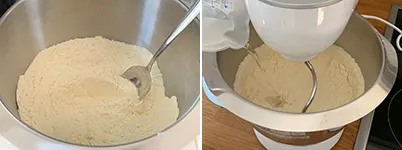
First, prepare the dough for our cuddurúni. This amount is sufficient for four to five focacce. To make the dough, start by placing the Tipo 00 flour, the semola di grano duro rimacinata, the sourdough starter (pasta madre), and the salt into a mixing bowl and briefly combine with a spoon. If you do not have sourdough starter on hand, you can substitute it with two cubes of fresh yeast. Dissolve the yeast in a small amount of water, let it rest for about ten seconds, and then add it to the bowl instead of the pasta madre and mix.
Next, knead everything either by hand or using a dough hook in a stand mixer on low speed, gradually adding about half of the lukewarm water.
Tip: If you cannot find semola di grano duro rimacinata, you can substitute it with a mixture of 2/3 Type 550 flour and 1/3 durum wheat semolina.
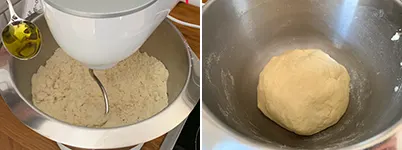
Next, add the olive oil and continue kneading, either by hand or in the stand mixer. Then gradually add the remaining lukewarm water, making sure to add it very slowly. You may not need all of the water, otherwise the dough could become sticky.
Knead the dough for about 15 minutes in total, or around 5 minutes by hand. In the end, it should be smooth, uniform, and not dry. As mentioned earlier, the amount of water is only a guideline—it may be that you need slightly less or a bit more. The finished dough must not be too moist or stick to your hands.
Once the desired consistency has been reached, briefly knead the dough by hand if you used a stand mixer, then shape it into a ball. Afterwards, let it rest and rise in a warm place with a stable temperature for about two hours. A switched-off and closed oven is ideal for this—just remember to cover the dough with a cloth.
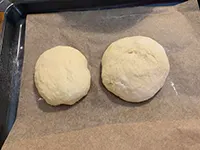
After one hour of resting time, divide the dough into four or five portions (depending on the desired final quantity). Briefly knead each portion again and let them rest for another hour and 15 minutes in the same warm place as described earlier.
If you are using fresh yeast instead of a sourdough starter, the dough should already be divided into the desired number of portions after 15 minutes and then left to rest for two hours.
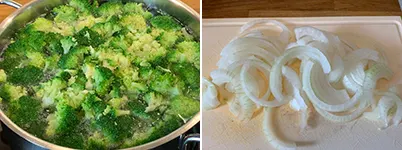
During the resting time, you can prepare the filling ingredients. Bring a pot of well-salted water to a boil and blanch the broccoli florets for about 8 to 10 minutes, depending on their size. They should be neither too soft nor too firm, as otherwise they may become too mushy in the first case or create holes in the dough in the second. Once they are nicely tender but still firm to the bite, drain them and set aside.
In addition, peel the onions and cut them into thin half-rings. Dice the Pecorino, pit and halve the olives, and, if desired, cut the mortadella into small pieces or tear it into smaller chunks by hand.
Tip: The mortadella is optional for those who prefer their focaccia to be a bit more savory.
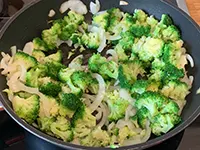
In the next step, heat 3 tablespoons of olive oil in a large pan and sauté the chopped onions until they become translucent. Then add the blanched broccoli florets, drizzle a little more olive oil if needed, and gently mix everything over low heat for about one minute. Remove the pan from the heat and let the mixture rest and cool for at least ten minutes.
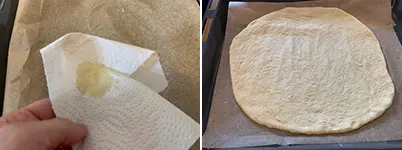
After the resting time, take one portion of the dough and roll it out—or shape it by hand—on a lightly floured work surface into a disc about 25–28 cm in diameter. Meanwhile, preheat the oven to its highest temperature with fan, usually around 250°C.
A crucial step for making Focaccia Siracusana successfully is to place an ovenproof bowl of water in the center of the oven’s bottom. This ensures that there is enough moisture during baking.
Line a baking tray with parchment paper and lightly brush it with a very small amount of olive oil. Then place the prepared dough disc onto the tray.
Tip: To ensure a good final result with a soft and tender dough, it is important to maintain a constant room temperature during handling. Drafts or similar changes in airflow should be avoided whenever possible.
At this stage, the filling for the Focaccia Siracusana can be added. First, spread the onion and broccoli mixture over one half of the dough, leaving about 2 cm free around the edges. Next, add the olives, Pecorino, and, if desired, the mortadella and lightly broken anchovy fillets. Finally, season with a little salt and pepper and drizzle with some olive oil.
Tip: Pepper can also be replaced with a bit of chili, depending on your taste preferences. However, it is important not to use both spices at the same time.
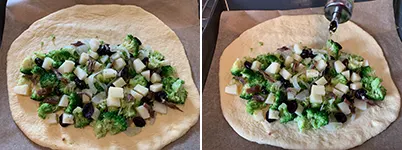
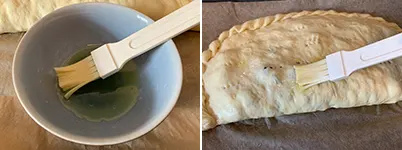
Now the focaccia can be sealed. To do this, fold over the top half to create the typical crescent shape. Roll and press the edges together with your fingers bit by bit so they resemble a cord or rope.
In a small bowl, mix a little olive oil with a tiny splash of water and brush the filled dough with this mixture. Then gently prick the top with a fork to prevent air bubbles from forming during baking. Be careful not to pierce all the way through to the bottom of the focaccia.
Once the focaccia has been placed in the oven in the next step, you can process the remaining portions of dough in the same way as described above.
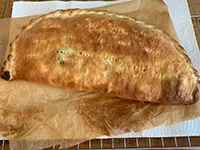
In the preheated oven, bake the cuddurúni / Focaccia Siracusana at the highest temperature with fan for about 15 to a maximum of 20 minutes. Be sure to remember the bowl of water, as it ensures the dough remains soft. The focaccia is ready when it has turned a beautiful golden brown, but it must not burn under any circumstances.
After baking, remove the tray from the oven and immediately place the focaccia on a wooden board or a wire rack so the heat can escape gradually. Otherwise, the heat would build up on the tray. Cover the filled focaccia with a cotton cloth as well.
The Focaccia Siracusana should cool for about 15 minutes before being cut into pieces and served. Buon appetito!
Tip: If you’d like to round off your meal with a glass of Sicilian wine, we recommend taking a look at our online shop, where you’ll find a selection of Sicilian red wines.